
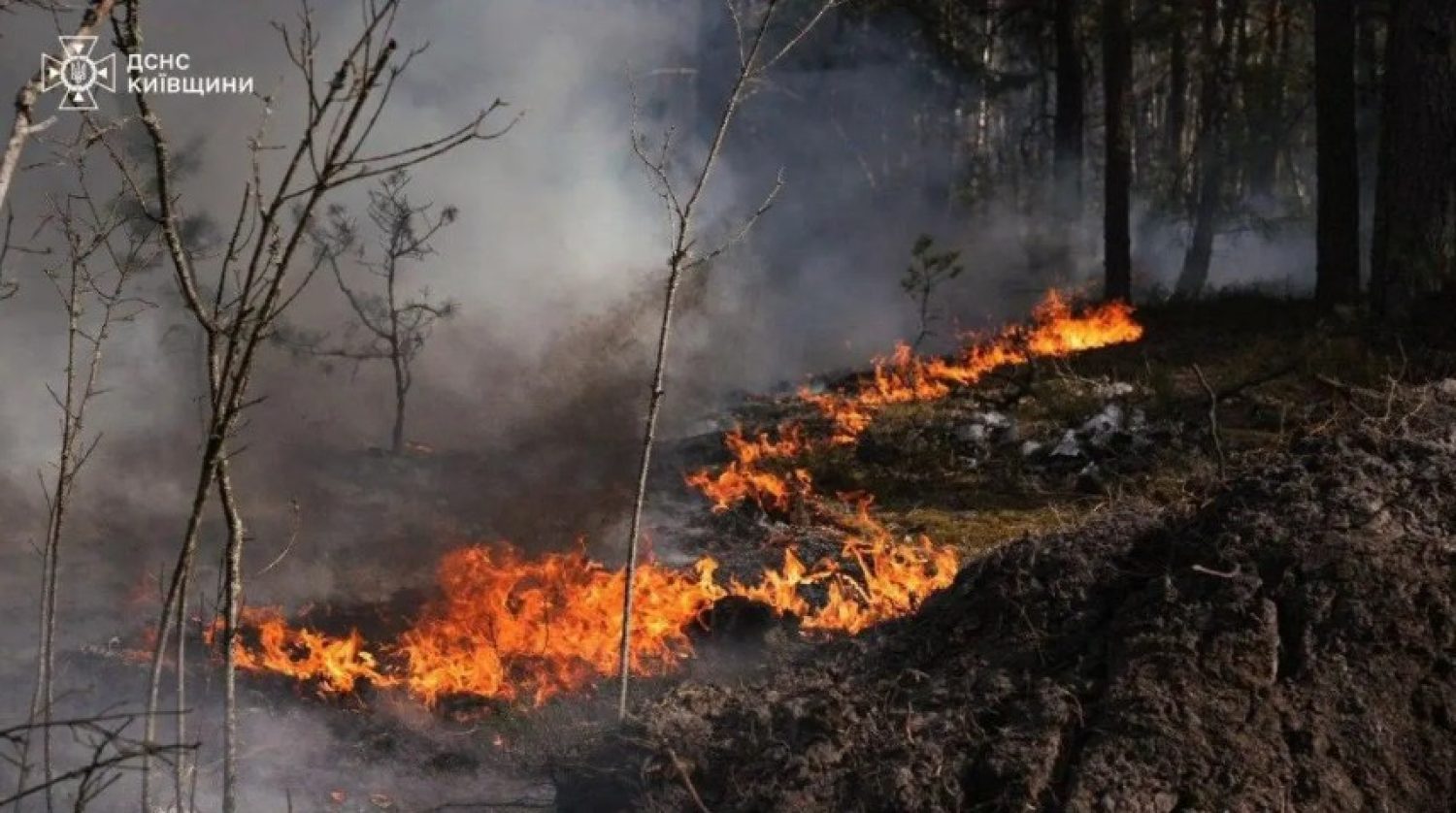
On Friday, 08 May 2026, an image published by Ukraine’s state emergency service showed a large column of white smoke billowing into the sky from the highly radioactive ‘Chornobyl Exclusion Zone’, confirming that a military drone crash sparked a rapidly expanding and uncontrollable inferno.
Emergency crews, already working under immense strain, have been forced to suspend operations due to the lethal risk posed by unexploded ordnance left behind by the ongoing war and high levels of radioactivity. This has left large sections of forest burning unchecked allowing radioactive contamination to spread once again into the air, the soil, and beyond.
Adi Roche, Voluntary CEO of Chornobyl Children International, has warned that radioactive contamination spreading, as a result of these fires, will cause further damage to the already fragile land and population in the region;
“If these fires cannot be controlled, we are facing another disaster on a massive scale. Fires are the primary way that radiation continues to be spread so many years after the accident and reminds us that radiation overpowers any human efforts to curtail its deadly impact on the environment and human health”.
On 24 February 2022, Chornobyl re-entered ‘centre stage’ for all the wrong reasons. News of the Russian invasion told of troop movement en route to Kyiv came via the world’s most toxic environment, the dreaded ‘Chornobyl Exclusion Zone’, re-releasing deeply buried toxic radioactive elements previously ‘locked in the land’, such as Caesium 137, back into the environment. Weeks later, Russian forces retreated from Chornobyl, with soldiers suffering from acute radiation poisoning. By digging tunnels, creating bunkers and dugouts in the ‘Exclusion Zone’, the troops were were exposed to the invisible enemy… the radioactive particles they inhaled and ingested.
Speaking on the potential catastrophic impact of the fires of human health, Roche said;
“As forest fires, and indeed radiation, knows no boundaries, the danger in this fire comes from the radioactive contaminants the burning plants and trees have absorbed. When the radiation landed on the ground in 1986 it absorbed by the trees, woodland and grasses. When these trees burn, the radiation is reactivated, carried by winds and inhaled by people. Internal radiation from inhalation is very much more dangerous and volatile than the background radiation that comes off the ground. It’s like Chornobyl all over again.”
The Chornobyl Exclusion Zone has vast silos of nuclear waste and water, which are highly dangerous and volatile. Fires sweeping through the highly radioactive region not only release radioactive particles into the atmosphere, but also deposits them into the soil and water. This feeds into the geochemical cycle, allowing radioactive materials to migrate through the environment and contribute to secondary radioactive contamination.
CCI declared that these new fires are the living proof of the necessity to declare nuclear facilities and surrounding infrastructure as ‘No War Zones’ and for international leaders to invoke the Hague convention which defines any attack on a nuclear facility to be a ‘war crime’.